
What Is Predictive Analytics in Marketing? Examples for Small Businesses
By Virtuance Digital Marketing · 12 November 2026
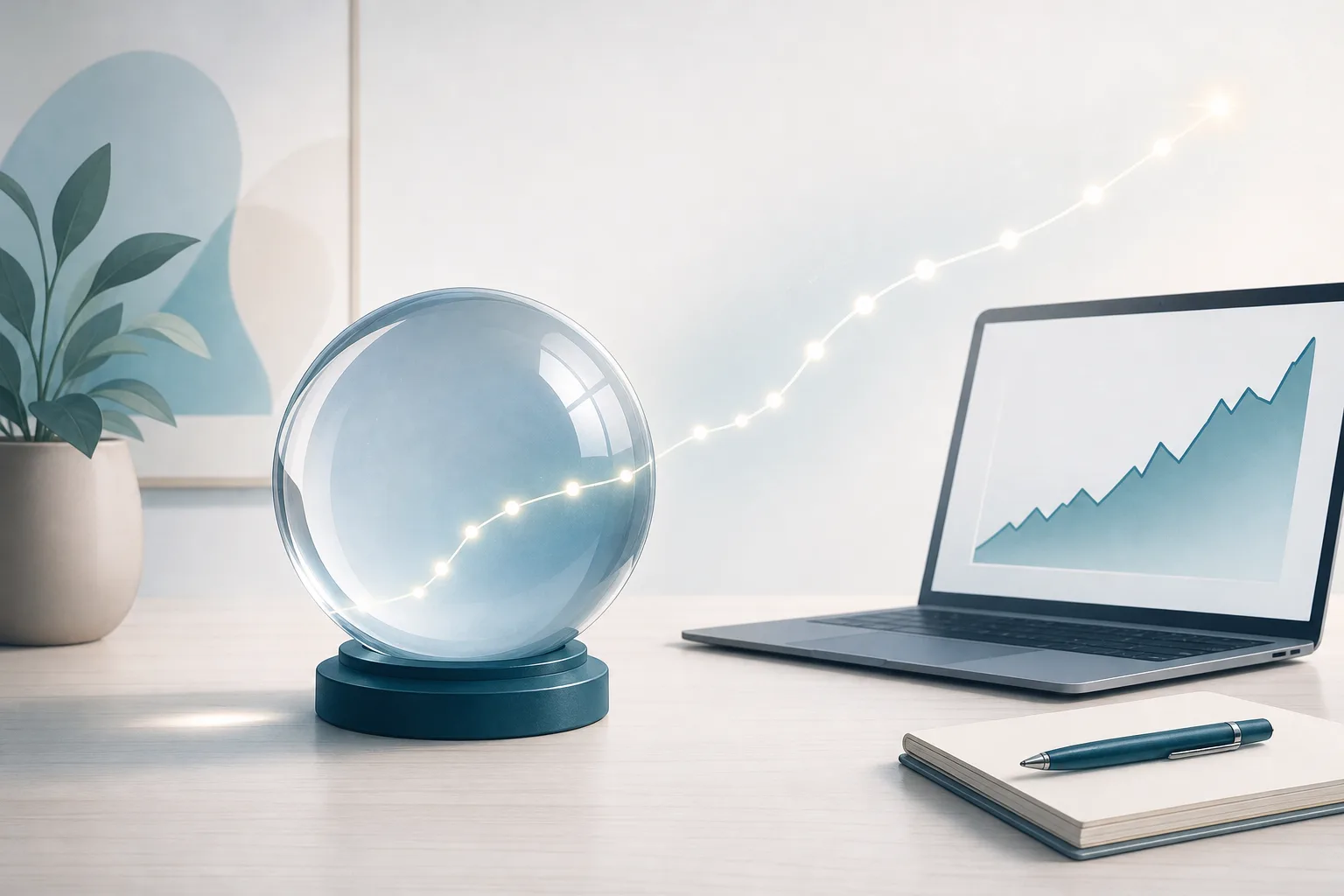
Predictive analytics in marketing uses your past data, together with statistical models and machine learning, to forecast what is likely to happen next. That might be which customers are most likely to buy, how a campaign may perform, or where demand in your market is heading. The aim is not to see the future with certainty, but to make better-informed decisions about where to spend time and budget.
What is predictive analytics in marketing?
Traditional reporting tells you what happened: how many people visited your website last month, which ad received the most clicks, which email was opened most often. Predictive analytics goes a step further and asks what is likely to happen next, based on the patterns in that history.
Machine learning models look through large amounts of data for relationships that are hard to spot by hand. For example, they may notice that visitors who read two particular pages and return within a week are far more likely to enquire. The model then uses that pattern to estimate how likely new visitors are to do the same.
The output is usually a probability or a forecast rather than a fixed answer. A good forecast comes with a sense of how confident it is, and it should be tested against what actually happens.
What can predictive analytics forecast?
In marketing, forecasts tend to fall into three groups.
User behaviour
Models can estimate which leads are most likely to convert, which customers may stop buying, and which visitors are likely to abandon a basket. This helps you decide who to follow up first and who needs a reminder or a different message.
Campaign outcomes
Based on previous campaigns, a model can estimate likely results before you commit the full budget, such as expected enquiries from a given channel or how performance may change if spend increases. This is useful when you are choosing between options.
Market trends
Search interest, seasonality and changes in demand can be modelled to anticipate when your audience is likely to start looking for what you offer. That gives you time to prepare content and campaigns ahead of a peak rather than reacting to it.
What are some examples for small businesses?
Predictive analytics is not only for large organisations. The principles apply at a smaller scale, provided you have enough relevant data. Here are some general examples.
- A local retailer looks at past sales by week and season to estimate when demand will rise, then schedules stock and promotions earlier.
- A professional services firm scores incoming enquiries by how similar they are to past clients who went on to buy, so the sales team contacts the likeliest prospects first.
- An online shop identifies customers whose buying pattern suggests they are about to lapse, and sends them a timely reminder or offer.
- A business running paid ads uses past campaign data to estimate which audiences and channels are likely to deliver the best return, and moves budget accordingly.
- A publisher or blogger studies which topics have grown in interest over time and plans content around them.
In each case the forecast does not replace judgement. It gives you a stronger starting point for a decision.
What data do you need for predictive analytics?
Models are only as good as the data they learn from. Before thinking about tools, check what you already collect.
- Website and app behaviour: pages viewed, time on site, forms started and completed, purchases.
- Customer records: past orders, order dates, enquiry sources and customer type.
- Marketing performance: spend, impressions, clicks and conversions by channel and campaign.
- Email and social engagement: opens, clicks, replies and follower activity.
- Seasonal and external factors: dates, holidays, promotions and market events that affect demand.
Two points matter more than volume. First, the data must be accurate and consistently recorded: a conversion that is tracked on some pages and not others will mislead any model. Second, it must be collected in line with privacy rules. If you are unsure how consent affects your analytics, our article on consent mode and data accuracy explains the issue. The ICO's website, ico.org.uk, is the UK regulator's main source of guidance on data protection.
How do forecasts shape marketing decisions?
A forecast is useful only if it changes what you do. Typical decisions it can inform include:
1. Budget allocation: shifting spend towards channels and audiences with the strongest predicted return.
2. Timing: launching campaigns ahead of expected demand rather than during it.
3. Targeting: focusing messages on the people most likely to respond.
4. Content planning: choosing topics your audience is starting to search for.
5. Retention: reaching customers who may be about to leave before they do.
It also pairs well with testing. Forecasts suggest where to look, and experiments confirm what works. If you are interested in that side, see our guide to A/B testing your website.
How do you get started?
You do not need to begin with complex models. A sensible sequence looks like this:
1. Decide on one question, such as which leads are most likely to convert.
2. Audit the data you hold and fix tracking gaps.
3. Start with a simple forecast and compare it with real results.
4. Review and refine regularly, since customer behaviour and markets change.
5. Build on what proves useful.
Be cautious about overconfidence. Predictions based on limited or poor-quality data can look precise while being unreliable, and unusual events can break patterns that held for years.
Frequently asked questions
Is predictive analytics only for large businesses?
No. Larger datasets generally allow more detailed models, but smaller businesses can still use their sales, website and campaign history to make simple, useful forecasts.
How accurate are marketing predictions?
Accuracy depends on the quality and amount of data and on how stable your market is. Forecasts are estimates, so it is sensible to compare them with actual results and adjust.
Do I need a data scientist?
Not always. Some analytics and advertising platforms include basic forecasting features. More tailored models usually benefit from specialist support.
How is predictive analytics different from normal reporting?
Reporting describes what has already happened. Predictive analytics uses that history to estimate what is likely to happen next, so you can act earlier.
Next steps
Virtuance Digital Marketing offers predictive analytics that uses AI and machine learning to forecast user behaviour, campaign outcomes and market trends. If you would like to talk about how forecasting could inform your marketing, contact the team on +44 7852 620882 or at contact@virtuance.co.uk.
Need help? Talk to Virtuance Digital Marketing
Get in touch
- Phone
- +44 7852 620882