

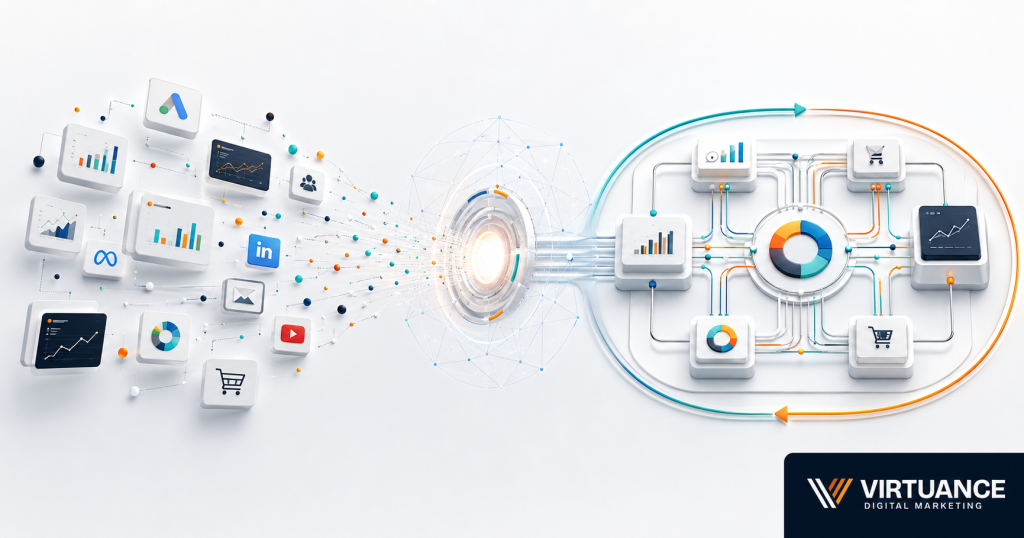
Most marketing teams do not have a shortage of technology.
They have analytics platforms, CRM systems, SEO tools, social media dashboards, content platforms, automation software and generative AI. Each system may perform its own function well. Yet despite this investment, marketing leaders often struggle to answer three basic questions:
What deserves our attention? What should we do next? Which activities are generating genuine commercial value?
The instinctive response is often to buy another tool. But for many CMOs, Marketing Directors and CEOs, the real problem is not a missing capability. It is the absence of a connected marketing architecture and a clear operating model.
More tools do not necessarily create more intelligence
A typical marketing ecosystem contains valuable data, but that data is frequently fragmented.
Website analytics measure traffic. Search platforms monitor rankings. CRM systems record leads and opportunities. Social media tools report engagement. AI visibility platforms track brand mentions and recommendations. Content teams manage production elsewhere.
These systems generate information, but someone still needs to bring it together, interpret it and decide what should happen.
A fall in organic visibility may appear in one platform. A new competitor may begin gaining recommendations across AI search. Website engagement may change. Sales teams may notice a decline in lead quality. When these signals remain separated, the organisation reacts slowly—or not at all.
Adding another dashboard does not solve this problem. It can simply create another source of information for an already stretched team to monitor.
Architecture connects the signals
A connected marketing architecture establishes how data, intelligence, decisions and execution work together.
It should connect the main stages of the marketing process:
- Business objectives and commercial priorities
- Customer, audience and persona intelligence
- Google and AI search visibility
- Website and content performance
- Competitor activity and market changes
- Lead intent and conversion signals
- Campaign execution
- Measurement and continuous improvement
The objective is not necessarily to replace every existing platform. It is to ensure that the most important signals can contribute to a shared view of performance and opportunity.
When this architecture is in place, marketing technology becomes more than a collection of reporting tools. It becomes a system capable of helping the organisation understand what is changing, why it matters and where the team should focus.
The operating model determines what happens next
Architecture alone is not enough.
A company may connect its data and still fail to act if there is no clear operating model. The operating model defines how people, technology and AI work together.
It should answer practical questions:
Who owns each marketing objective? Which signals should trigger action? What can AI prepare or execute? What requires human approval? How are priorities agreed? How are results measured? How does the organisation learn from previous actions?
Without these rules, even good insights can remain trapped in reports and meetings.
A strong operating model creates a continuous cycle:
Monitor → Identify → Prioritise → Act → Measure → Improve
This is particularly important as organisations begin adopting agentic AI.
Generative AI can draft an article, create a social post or summarise a report when someone provides a prompt. An agentic marketing system can go further by continuously working towards a defined objective: monitoring relevant signals, recognising an opportunity, recommending the next action, preparing the work and evaluating the outcome.
However, AI needs context, boundaries and human oversight. It must understand the company’s audiences, services, positioning, priorities and approval requirements. Otherwise, it may simply produce more content rather than better commercial decisions.
AI can magnify fragmentation
Many organisations are currently adding AI to individual departments and marketing tasks. Content teams use one system, analysts use another and sales teams introduce separate automation.
This may increase the speed of individual activities, but it can also magnify fragmentation.
Producing more content is not helpful if the organisation does not know which topics influence customers. Automating outreach is not valuable if the system cannot distinguish between weak engagement and genuine buying intent. Increasing website traffic is not enough if that traffic does not produce qualified opportunities.
The advantage of AI emerges when it operates as part of a connected architecture—not as another isolated application.
Luciqo AI as the intelligence brain
Luciqo AI is designed to become the intelligence brain within this connected marketing environment.
It helps organisations bring together visibility, audience, competitor, reputation and intent signals so marketing teams can identify opportunities and establish clearer priorities. It can support monitoring across Google and AI platforms, reveal where a brand is underrepresented, and help determine which activities deserve attention.
Virtuance Digital Marketing provides the strategic and execution layer around that intelligence. We help organisations translate Luciqo AI’s insights into SEO, GEO, AEO, content, digital reputation, website and conversion activities.
The purpose is not to remove the marketing team or hand uncontrolled autonomy to AI. It is to reduce repetitive monitoring, connect fragmented information and give experienced marketers better intelligence for decision-making.
Human control remains central to strategy, brand positioning, creative judgment, compliance and publication.
Build the system before buying another tool
Before investing in more marketing technology, leaders should examine the system they already have.
Can your platforms share meaningful intelligence? Does your team know which signals require action? Are Google visibility, AI recommendations, content, website behaviour and commercial outcomes connected? Can you measure whether marketing actions produce genuine business results?
If the answer is no, the solution may not be another tool.
It may be a connected architecture, supported by a practical operating model, that allows technology, AI and people to work towards the same commercial objectives.
That is the foundation of effective agentic marketing—and the type of tailored system Luciqo AI and Virtuance Digital Marketing can help your organisation build.